Telegram channel DMs or comments: choose where requests belong
Choose between public comments, channel direct messages and a verified support route. Check staff access, test the entry point and recover a misrouted request.
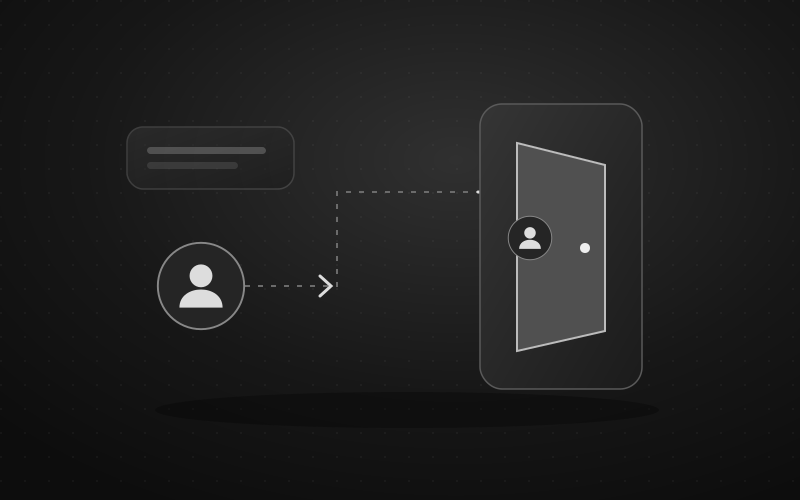
Use comments when the question and answer belong with a public post. Use channel direct messages when a person needs to contact the channel's staff without starting a public discussion. Use your established support route when the request needs account verification, restricted case access or a process the channel inbox does not provide.
These choices can coexist. The important decision is what readers should send to each destination and who will take responsibility once it arrives. Opening another inbox without assigning a reader creates another place to lose requests.
Comments and channel DMs have different audiences
Telegram's Channels FAQ explains that post comments also appear in the linked discussion group. They are a shared conversation, not a private note to the author. Check the audience of that group before asking somebody to add a screenshot or personal example.
The channel-DM announcement describes a separate inbox where readers can contact a channel without the owner publishing a personal account. That makes an official contact route possible; it does not by itself establish a support team, a response deadline or suitable handling of confidential documents.
For a channel with public comments, make the distinction visible before the reader types. “Questions about this post go in comments; individual requests go to the channel inbox” is useful only if staff actually monitor both.
Choose the route by the information needed
The following cases are hypothetical. “Verified support route” means an entry point published on the organization's own trusted site or channel, not an unsolicited account claiming to be support.
| Request | Suitable starting point | Check before asking for more |
|---|---|---|
| “Which version does this announcement describe?” | Comments under the post | Can the reply help other readers without personal details? |
| “I found an error and want to contact the editors.” | Channel DMs, if staff cover that inbox | Who can read it, and who will own the reply? |
| “Please check an issue with my individual account.” | The established support route | Does it provide the required verification and case access? |
| “I cannot post in your discussion group.” | A published appeal route outside the restricted group | Can this person reach it with their current access? |
Consider a small software community announcing an update. A question about a changed menu stays in comments so others can use the answer. A reader pointing out an editorial typo can contact the channel privately. An account problem goes to the official support process, initially with a short description rather than identity documents or an unredacted account export.
This is a routing decision, not a reason to hide criticism. “The update is disappointing” can remain a public comment under the ordinary rules. Move the details that need a smaller audience, not every uncomfortable opinion. The support-group guide covers handling the underlying complaint.
Who can read channel direct messages?
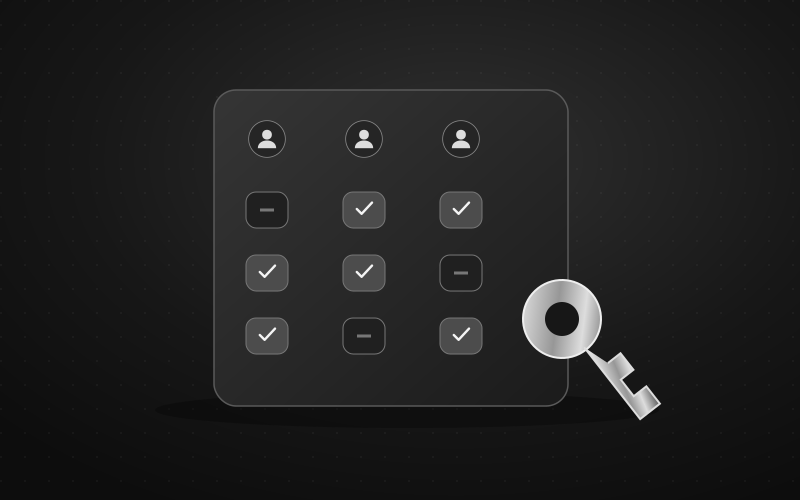
According to Telegram's channel-DM specification, each reader has a separate conversation with the channel. Channel administrators with the direct-message management permission can view and reply across those conversations. Replies are sent as the channel.
Do not describe the inbox as “only you and the owner” or promise that only the assigned responder can see a request. Assigning a case to one person is a working arrangement; it does not narrow the documented permission to that one conversation.
Before opening the inbox, make an access list:
- Who has the channel's direct-message management permission, and why?
- Which authorized person handles an unanswered request when the usual responder is absent?
- Are any bots connected with access relevant to this inbox? What do their operators say they receive, store or send onward?
- Where will staff record a handoff, and can that record omit the original private content?
Telegram exposes direct-message administration rights and channel-DM capabilities for bots. A platform capability is not evidence that a particular bot implements it. Review each service separately; the bot-access guide explains the questions to ask.
Give inbox access according to the work a person actually does. A volunteer who moderates public comments may not need to read individual requests. Check the native channel permission separately from their role in a discussion group or another tool.
Publish a short intake policy
Write four things in the channel's contact instructions: what belongs in comments, what the inbox accepts, when it is staffed, and where account-specific cases should go. Use hours and response expectations your team can keep; message delivery is not a promise of immediate attention.
For example, a hypothetical editorial channel might publish: “Discuss the post in comments. Send corrections to the channel inbox; our editorial team can read them. For account help, use the support link on our official website. Do not send passwords, login codes or payment-card details.” Replace this with your real process before publishing it.
Keep the destination recognizable. Link from the official channel or website rather than telling readers to search for a display name. Explain that an unexpected personal message from a supposed staff member is not proof that it belongs to the published support process.
For a channel with a username and direct messages enabled, Telegram documents the direct-inbox link format t.me/<username>?direct. Use your channel's actual username and check the destination in the clients your audience uses. Documented link syntax does not replace that reader-side test.
Do not make a new inbox the only route for an appeal until you have checked that affected readers can use it. Similarly, a request that needs a specialist team should not depend on an editor forwarding sensitive screenshots into a general staff chat.
Check the payment setting as part of that decision. Telegram lets channel owners charge Stars for direct messages. Before directing support requests or appeals there, check whether your channel charges and tell readers what to expect. Publish a usable alternative for people who cannot or do not want to pay; do not assume the inbox is free because it opens successfully.
Test the journey with harmless messages
Treat the following as an acceptance plan, not evidence of a live test already performed. Use consenting participants and invented details; administrator accounts alone cannot show the reader experience.
- Start at the public place where the contact link is published. Confirm the exact channel and destination reached by an ordinary reader. Before sending, check whether the reader is asked to pay Stars.
- Send a clearly labeled test request. Check which authorized staff accounts can see it and which account is responsible for responding.
- Reply and verify what the reader sees. Confirm that no private test text was copied into comments or the public channel.
- Test the fallback route, including the path for a reader who cannot post in the discussion group or use a paid inbox. Record any unmet access or payment requirement instead of assuming it away.
- Rehearse a handoff: the second responder acknowledges ownership and can find the relevant request without making the reader post private information again.
- After changing staff access, repeat the access check before handling real requests. Review any connected service separately.
A link that works on the owner's device is not sufficient. Check the entry paths and official clients your audience actually uses. If a result differs, record the client version, starting link, account role and visible error using a redacted example. Do not turn an old support report into a blanket claim about current Telegram compatibility.
Recover a wrong destination without losing the request
If the entry link fails, keep the verified alternative visible while diagnosing the failure. Compare the published destination with the intended one and try the route from the channel itself. Do not ask the reader to send account details to a newly suggested personal username as a workaround.
If the message arrived but nobody replied, check inbox coverage and responsibility before changing permissions or deleting conversations. A read request can still be unresolved. Keep a small non-sensitive record of the owner, next step and last reply in the team's chosen process; this is a human procedure, not a promised Telegram ticketing feature.
If somebody posts private details in comments, limit further exposure using the available moderation controls and point them to the established private route. Do not quote the details in the public explanation. Removing a post cannot retract copies already received. If a secret was exposed, use the relevant provider's official recovery process rather than treating message deletion as sufficient.
If the wrong staff member had inbox access, correct the permission and review onward copies or integrations as a separate issue. Revoking access does not prove that previously read material has disappeared from every place it reached.
Keep Defendy's role tied to the verified surface
Defendy's documented group moderation is relevant to the linked discussion group. Use the comments-protection guide for that setup. Do not assume those filters also process the channel's direct messages: Defendy channel-DM moderation has not been verified for this guide.
Likewise, Defendy roles govern supported bot actions; they are not a grant of native channel-inbox access. Moderation logging has a configured destination and event categories. Check its intended audience, but do not treat it as a complete private-support transcript or evidence that a DM was handled.
The finished setup should let a reader answer three questions without guessing: where should I write, who may read it, and what happens if that route fails?
Sources and scope
Reviewed on 6 October 2026 against the linked official Telegram documentation and Defendy's implementation. Examples and checks are proposed operating practices. No live channel inbox, account-access change or client-compatibility test was performed. This guide does not establish a confidential-document intake service or Defendy support for channel DMs.